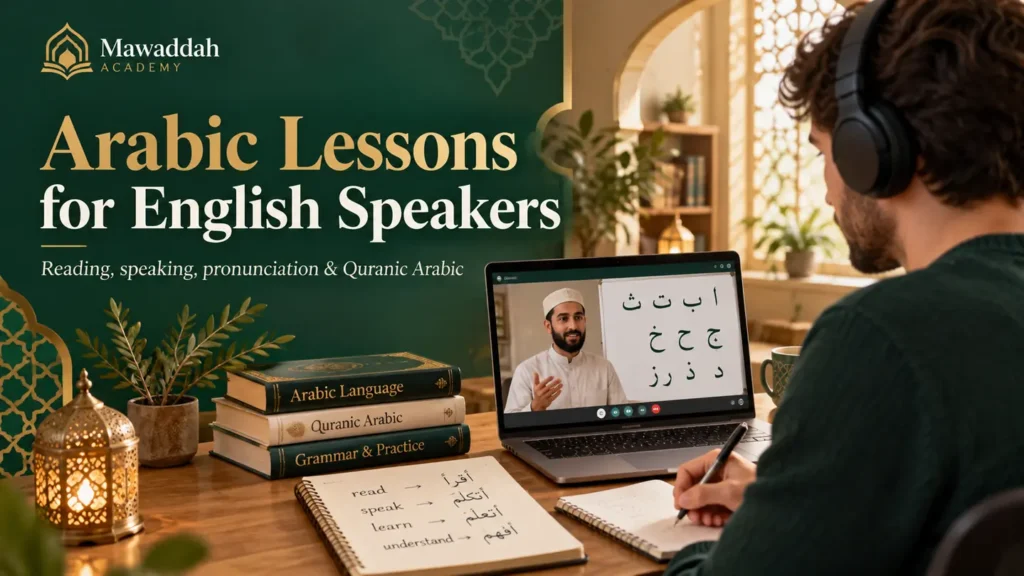


Learning Arabic online from scratch becomes much easier when the journey is divided into clear stages. Beginners do not need to learn the alphabet, grammar, conversation and Quranic vocabulary all at once. A strong Arabic learning plan builds one layer at a time and keeps speaking, listening, reading and writing connected.
Stage 1: Arabic letters and sounds
The first step is recognising Arabic letters in their different forms and producing their sounds accurately. This foundation matters for both everyday Arabic and Quran reading.
Stage 2: Joining letters and reading words
Once letters are familiar, learners practise how letters connect inside words. Short vowels, common patterns and guided reading help turn recognition into real reading ability.
Stage 3: Core vocabulary and useful sentences
Vocabulary should be practical and reusable. Students learn words in context and begin building short sentences rather than memorising disconnected lists.
Stage 4: Listening and conversation
Online Arabic classes should include active listening and speaking. The learner needs chances to ask, answer, describe and react—not only read from a screen.
Stage 5: Grammar that supports communication
Grammar is important, but it works best when introduced at the point where it helps the learner understand and produce better sentences. Beginners rarely benefit from receiving too many technical terms too early.
Stage 6: Quranic Arabic or advanced goals
Learners who want Arabic for Quran understanding can gradually focus on high-frequency Quranic vocabulary and common structures. Others may prioritise conversation, reading fluency, writing or formal Arabic.
Arabic classes for children vs adults
Children often need shorter tasks, visual repetition and a predictable routine. Adults may prefer explicit explanations and faster movement through familiar concepts. Placement and teacher matching should reflect these differences.
Private Arabic tutoring or small groups?
Private 1-to-1 Arabic lessons provide maximum speaking and correction time. Small groups can add interaction and peer practice when students share a similar level.
How often should you study Arabic?
Two or three live classes per week can create steady progress when combined with short practice between lessons. Learners with intensive goals may choose four or five lessons weekly or a daily plan.
What should an online Arabic learning system track?
- Current level and learning goal.
- Lesson schedule in the learner’s time zone.
- Attendance and lesson history.
- What was covered in each class.
- Homework and the next target.
- Periodic progress scores.
Start with the right level
Knowing a few Arabic words does not always mean the learner can read, write or build sentences. A placement review helps the teacher identify the strongest and weakest areas before the learning plan begins.
Explore Mawaddah online Arabic classes or request an Arabic level review.
Modern Standard Arabic, Quranic Arabic or conversation?
“Learn Arabic” can mean different things. Some learners want Modern Standard Arabic for reading and formal communication, some want conversation, and others want Arabic mainly to support Quran understanding. A placement conversation should identify the goal early so the teacher can prioritise the right vocabulary and activities.
How long does it take to learn Arabic?
There is no fixed number of months because progress depends on starting level, lesson frequency, practice time and goal. A learner studying three times per week with short daily review will usually build momentum more consistently than someone relying on one long lesson with no practice between classes.
What should beginners practise between classes?
- Read a small set of letters or words aloud.
- Review vocabulary in complete phrases.
- Listen to short recordings and repeat.
- Write a few words or sentences by hand or keyboard.
- Revisit teacher corrections before the next class.
Common mistakes when learning Arabic online
Beginners sometimes rush into grammar before reading becomes comfortable, memorise vocabulary without using it, or avoid speaking because they are afraid of mistakes. A teacher can sequence these skills so the learner practises them together.
Arabic lessons for non-native speakers
Non-native speakers benefit from explanations that connect sound, meaning and sentence use. Lessons should not assume that the student hears Arabic at home. Clear repetition and controlled progression are especially useful for children growing up outside Arabic-speaking countries.
Can Arabic support Quran learning?
Yes. Even a modest Arabic foundation can help learners recognise recurring Quran vocabulary and sentence patterns. Quranic Arabic should still be introduced at the right stage so the learner is not overwhelmed.
FAQ: learning Arabic online
Can I learn Arabic without knowing any letters?
Yes. The first stage can begin with letter recognition and pronunciation.
Can I learn Arabic with a private teacher?
Yes. Private lessons are useful when the learner wants maximum speaking and correction time.
Do children and adults follow the same course?
No. The pathway can share the same core skills, but lesson length, examples and pace should be adapted to age.
How can parents track a child’s progress in online Arabic lessons?
Pick one skill to track each week. For a beginner, that could be recognising letters in new words. For a child who hears Arabic at home, try asking them to answer a familiar question in a full sentence. Use the teacher’s lesson notes and homework to compare what the child can do independently.
Explore online Arabic classes for children and non-native speakers or request two free trial lessons.
Arabic learning resources
Combine structured practice with direct correction and an appropriate lesson schedule.